Installation is where most piping systems either hold up or start failing quietly.
On paper, everything looks correct. The right joint is selected, the specs match, and the drawings are approved. But once installation begins, small deviations creep in. Alignment isn’t perfect. Supports are slightly off. The joint is stretched just a bit to make it fit.
None of this looked serious at the time.
But that’s exactly how problems begin.
Proper Expansion Joint Installation is not just about placing a component between two pipes. It’s about making sure that the joint performs the way it was designed to under real operating conditions.
If installed correctly, expansion joints protect the system. If not, they become the weakest point.
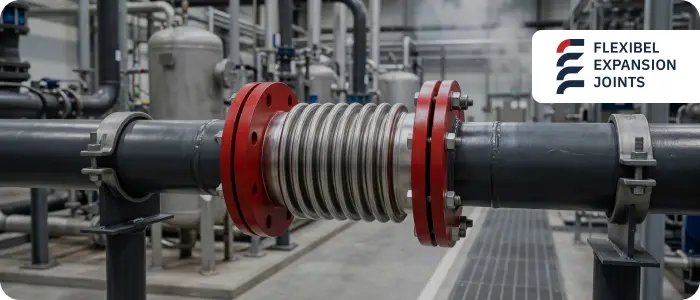
A high-quality joint can still fail early if installed incorrectly.
That’s something most engineers realize only after facing repeated issues. In many cases, the problem isn’t the joint; it’s how it was installed.
Whether it’s a Pipe Expansion Joint Installation, Flexible Joint Installation, or Compensator Joint Installation, small errors during setup can lead to:
This is why following proper Expansion Joint Best Practices is critical from the start.
Not all joints behave the same way.
To deal with high temperatures and pressures, metallic expansion joints have a bellows that can cope with the differential expansions and contractions that occur as a result of thermal or mechanical changes. Because of the possibility of damage to the bellows, it is essential to take care when installing these types of joints.
Rubber Expansion Joints are designed for flexibility and vibration isolation. These are commonly used near pumps and require correct alignment to function properly.
Fabric Expansion Joints used mainly in duct systems. They are lightweight but sensitive to installation conditions like tension and positioning.
Each type requires a slightly different approach during Expansion Joint Installation.
Before starting, a few basic checks can prevent bigger issues later.
Skipping these steps is one of the most common mistakes in expansion joint installation.
The joint should line up naturally with the pipes. Never force joints into alignment.
When a pipe expansion joint is not aligned during installation, it will be subjected to constant stress, decreasing the life of the expansion joint.
Pre-stressing occurs when you stretch or compress during an expansion joint installation.
An expansion joint is designed to accommodate movement during normal operation, not during installation.
The supports will have control over how the system will move.
If the supports are not installed correctly, the joint may then sustain unintended loadings, leading to failure.
When the connections are not tightened uniformly, pressure points can develop.
This is particularly true for a flexible pipe connector installation or flexible joint installation because correct sealing and alignment are critical.
Expansion joints need space to move.
Blocking or restricting this movement defeats the purpose of installing the joint.
A simple expansion joint installation checklist can make a big difference:
This checklist helps ensure that expansion joint installation steps are followed correctly.
Even experienced teams make mistakes.
Some of the most frequent ones include:
These errors often lead to early failure, especially in Industrial Expansion Joints.
Installation doesn’t end once the joint is in place.
Post-installation Expansion Joint Inspection is essential.
It helps verify:
This step is often skipped, and that’s where problems begin.
Proper Expansion Joint Maintenance ensures long-term performance.
This includes:
Even High-Performance Expansion Joints need periodic maintenance.
Installation isn't only about technology; it's also about practicality. Companies like Flexibel exist because of their expertise in installation across all types of environments (UAE, Saudi Arabia, Qatar, Bahrain & Kuwait, etc.) and how real systems act. Their approach goes beyond supplying products.
Flexibel focuses on:
Working with an experienced Expansion Joint Manufacturer ensures that installation is done right, not just completed.
For industrial systems, proper expansion joint installation is just as critical as selecting the right product. Partnering with experienced specialists helps prevent premature failures, costly downtime, and safety risks. Flexibel Expansion Joints provides engineered expansion joint solutions along with expert guidance for installation, inspection, and long-term performance across demanding industrial environments.
Contact our team today to discuss your project requirements and ensure reliable system operation from day one.
In complex systems, expansion joints are part of a larger design.
Proper Piping Design considers:
Ignoring these factors often leads to installation issues, even when the joint itself is correct.

There is always a reason why an Expansion Joint fails. In most cases, the reason can be traced back to installation. If proper Expansion Joint Installation Guides are followed, the joint will perform as it should. It will absorb the movement/changes, reduce stress, and protect the system. When looking at industrial piping systems, the difference between long-term performance and multiple failures is usually due to the quality of the installation.
Expansion joints should be installed correctly by following four important steps: alignment, avoiding pre-stressing of the joint, proper support placement, and verifying movement.
If these four steps are completed properly and in a timely manner will prevent problems from occurring and provide high system performance.