If you walk through any oil refinery, operating plant, power station, or large HVAC, it becomes immediately noticeable how much movement occurs within these facilities: pipes constantly heat up and cool down; there are small movements or shifts of the piping due to temperature fluctuations; and all of the equipment causes some level of vibration throughout the facility.
Individually, these movements might seem minor. But over time, they add up. That’s when you start seeing the early signs, flange leaks, stressed welds, and alignment issues. Not because the system was poorly built, but because movement wasn’t properly managed.
That’s exactly where Expansion Joints come in.
They act as flexible points in otherwise rigid systems. Instead of letting stress travel through pipelines, they absorb it. In practical terms, they protect the system from its own operating conditions.
In industries where systems run continuously, relying only on rigid piping is never enough. Properly selected Piping Expansion Joints become part of the system’s long-term stability, not just an add-on.
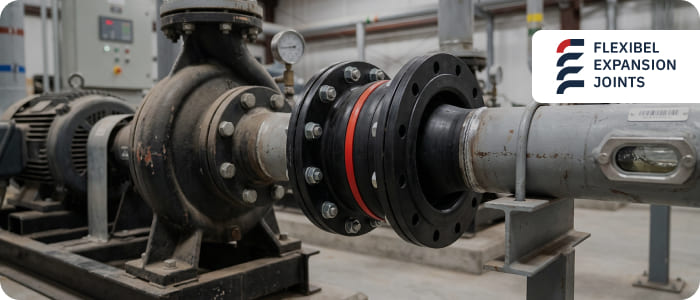
On a fundamental level, Expansion Joints are designed to allow for movement that can occur due to changes in temperature, vibration, variations in pressure, and some Minor Misalignment
But when you look at how they are used day-to-day, this is only part of what they do.
They:
From the design and manufacture of Expansion Joints to the Installation of Expansion Joints, every stage affects how well they perform.
In systems like oil pipelines or steam lines, even a few millimeters of unabsorbed movement can lead to long-term issues. Expansion joints stop that buildup right from the start.
Learn More: What Are Expansion Joints? A Complete Guide by Industry Experts
Different systems need different designs, and choosing the wrong type can lead to performance issues.
1. Metal Expansion Joint solutions: A wide range of Metal Expansion Joint solutions is used where pressure and temperature are high. They are generally used in refineries and power plants. They’re built to handle stress without losing structural integrity.
2. Rubber Expansion Joints: Rubber Expansion Joints are usually installed near pumps or compressors. Their strength is flexibility; they absorb vibration and reduce noise to protect connected equipment.
3. Fabric Expansion Joints: Fabric Expansion Joints are often used in ducting systems.They’re lightweight, flexible, and perform well in applications where large movement needs to be absorbed without heavy structural load.
4. Metallic Flexible Hoses: Metallic Flexible Hoses are used where both flexibility and durability are required.You’ll often find them in turbine connections or equipment interfaces where movement is unavoidable.
Read More: Understanding Expansion Joints: Types, Manufacturing, and Benefits
1. Improved System Flexibility: Rigid systems can’t handle movement well. Expansion joints have controlled flexibility, allowing pipelines to expand, contract, and shift without increasing internal stress.
2. Vibration and Noise Reduction: Equipment like pumps and compressors vibrates constantly. Without proper isolation, vibration travels through the pipeline. Expansion joints absorb it at the origin, reducing long-term damage and noise.
3. Thermal Expansion Management: Temperature change is one of the biggest problems in piping systems. Expansion joints absorb movement and prevent issues like pipe distortion or misalignment.
4. Extended Equipment Lifespan: When stress and vibration are controlled, equipment lasts longer. Valves, pumps, and connected systems experience less wear, which reduces maintenance frequency over time.
Expansion joints are closely tied to piping engineering and on-site services.
A well-designed joint is only effective if it’s installed and maintained correctly. That’s why many projects include On-site services for Expansion Joints, ensuring alignment, correct positioning, and proper functioning.
In reality, improper installation can increase issues more than the product itself. Getting it right the first time makes a huge difference.
The Installation of Expansion Joints needs to be detailed.
Key points include:
Even small errors here can shorten the lifespan of the joint.
Regular inspection isn’t optional; it’s necessary.
Properly Installed Expansion Joint Inspections help identify early signs of wear:
Knowing these early prevents large failures.
Over time, all parts wear out. Expansion joints are no exception.
Routine service Expansion Joints activities include checking movement behavior, inspecting surfaces, and ensuring connections remain secure.
In cases where damage is visible, replacements of Expansion Joints should not be delayed. Waiting too long often leads to system-wide issues.
Industries often rely on a combination of On-site services for Expansion Joints and Expansion joints technical consulting.
These services help:
In complex systems, this kind of support helps avoid repeated problems.
Standard solutions don’t always work, especially in complex industrial environments.
This is where Custom Expansion Joint Solutions for Industrial Applications come into play.
A Custom Metal Expansion Joints Manufacturer can design joints based on:
This gives better performance and longer service life.
Not all suppliers are reliable.
Working with reputed Expansion Joint Manufacturers & Suppliers ensures:
A supplier offering a wide range of Metal Expansion Joint solutions can better match specific application needs.
The effectiveness of an expansion joint depends heavily on its bellows.
Reliable and suitable Piping Expansion Bellows are designed to handle movement without compromising strength. They allow flexibility while maintaining pressure integrity, a balance that’s critical in industrial systems.
Modern industries demand more from piping systems.
Advanced Expansion Joint Solutions now focus on:
From Piping Expansion Joints in refineries to specialized applications in power plants, expansion joints continue to get upgraded with industry needs.

Temperature, pressure, and vibration place constant strain on piping systems; it is at this point that things go wrong if the strain is ignored.
Because this is true, Expansion Joints are not optional components of a system but are part of maintaining the stability of the system.
Whether they are rubber Expansion Joints, Fabric Expansion Joints, or Metallic Flexible Hoses, all provide effective movement control for piping systems.
When properly selected, installed, and maintained, the expation joint will perform as intended, and nobody will know they are there, which is what you want to have happen!