Today's industrial piping and ducting systems constantly experience stressors associated with changing temperatures, mechanical vibration, and some kind of movement associated with operating environments. The material of a piping or ducting system will expand and contract every time the equipment heats and cools. Without a proper way to absorb these movements, systems will begin to crack, leak, misalign, and fail prematurely. This is where the use of fabric expansion joints will make a difference.
Fabric expansion joints are flexible, durable, and specifically designed to work in harsh conditions, and they provide a durable way to ensure performance stability and operational safety. Fabric expansion joints in industrial applications, even in power plants, cement factories, chemical processing, and refining them to help ensure the longevity of equipment and efficiency across industrial applications.
After the first two hundred words, we can acknowledge that trusted providers, such as Flexibel, are becoming a larger part of supplying and designing engineered industrial fabric expansion joints for operational safety and durability, as well as flexibility for long-term applications.
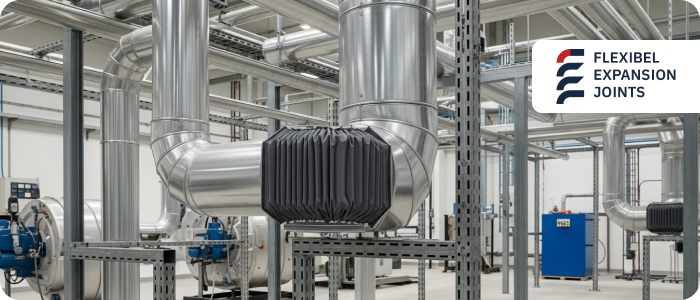
Fabric joints are engineered connectors used to absorb thermal movement, vibration, and mechanical shifts in industrial ducting and piping systems. They are commonly installed between components that experience movement due to temperature fluctuations or operational functions.
These joints are made with layers of heat-resistant materials, including PTFE, fluoropolymers, fiberglass, silicone, or elastomeric fabrics. Today's flexible fabric expansion joints are manufactured to endure conditions of corrosive gases, steam, dust and extreme temperatures.
See also: Expansion Joints: Custom Solutions for Industrial Applications
Depending on application requirements, movement type, and environmental exposure, several configurations exist, including:
A reliable fabric expansion joints manufacturer typically customizes the construction based on industry specifications such as movement range, media type, temperature rating, and environmental exposure.
Fabric expansion joints are widely used across numerous sectors due to their versatility and ability to perform where metal joints may fail. Common areas of use include:
Industries requiring resistance to abrasion, chemical exposure, vibration absorption, and flexibility rely heavily on industrial fabric expansion joints to maintain system integrity.
See also: Quality Manufacturer of Bellow Expansion Joint for Modern Industries
In many industrial systems, temperatures may vary by hundreds of degrees causing pipelines and ducts to repeatedly expand and contract. Be aware that the stresses placed on structural connections are exacerbated in a high vibration scenario, such as with fans, blowers, compressors, and exhaust systems.
This is why fabric expansion joints are important in industrial plants. They provide functional benefits including:
They help ensure smooth operations and minimize downtime or mechanical failure, making them a strategic component rather than an optional one.
Choosing corrosion-resistant expansion joints made from high-quality materials provides multiple operational benefits, including:
Additionally, the benefits of using fabric expansion joints include longer lifespan in corrosive and abrasive settings, reduced maintenance frequency, and better tolerance for misalignment and operational shifts.
See also: Your Guide to Metal Expansion Joints: Design, Uses, and Advantages
Metal joints are resistant to pressure and durable. However, they do not offer flexibility and can corrode in aggressive environments. Rubber joints provide flexibility in joints but tend to erode in high-temperature services or chemical environments.
In comparison, fabric expansion joints offer:
This makes them an ideal solution when operational flexibility and environmental resistance are required.
When determining the proper solution, you should consider temperature limits, chemical exposure, direction of movement, pressure in the system, and installation geometry. An experienced fabric expansion joints vendor in the UAE or any reputable source in the market may also review conditions for airflow, level of particulates and system vibration.
Key considerations include:
If you're unsure how to choose the right fabric expansion solution, consulting with expert engineers or a reputable fabric expansion joint suppliers network ensures proper product matching and long-lasting performance.

Performance, reliability and safety in industrial environments are absolutely reliant upon the correct connectors and protection solutions. Fabric expansion joints will remain irreplaceable because of their flexibility, sustainability, corrosion resistance and ability to withstand drastic temperature changes. As industrial systems become more complex, the demand for customized, application-specific, high-performing designs will only increase.
Mainly, they are used in refineries, power plants, cement industry, HVAC, steel processing, and industrial ductwork.
They help absorb vibration, thermal movement, and operational changes, keeping a stable system to help prevent mechanical failure.
They typically consist of fiberglass, PTFE, fluoropolymers, silicone coated fabrics, and other heat-resistant materials.
Typically, fabric expansion joints have greater flexibility, better vibration mitigation, and improved corrosion and temperature resistance compared to rubber and metal.
Yes, fabric expansion joints can be designed depending on construction and materials to withstand extremely high operating temperatures.