If you’ve spent any time around industrial piping systems, you know pipes are never fully stable. They increase in size as temperature rises and decrease as temperature falls, and they are subject to continuous vibration from pumps, compressors, and flow variations.
All of this movement causes stress to be put on the system over time; that stress will not dissipate by itself. Stress appears where you least want it - at welds, flanges, supports, and joints. And when it reaches a limit, something gives.
This is where Pipe Expansion Joints come into play.
A Pipeline Expansion Joint isn’t just another fitting. It’s a controlled flexibility point in a rigid system, something that absorbs movement so the rest of the pipeline doesn’t have to. In industries like oil & gas, power generation, and marine operations, this isn’t optional. It’s part of keeping systems running without interruptions.
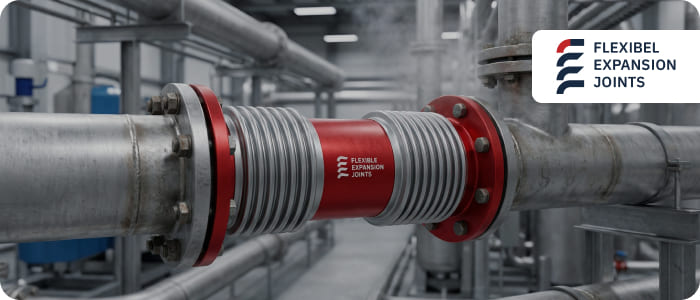
Without properly designed Expansion Joints for High-Pressure Steam Systems, even small amounts of unaccounted movement can lead to long-term failures.
A Pipe Expansion Joint is a flexible connector installed within a pipeline to handle movement caused by thermal expansion or contraction of the pipeline, pressure changes, vibration, and even installation misalignment.
Most designs rely on corrugated Pipe Expansion Bellows that expand and compress in response to system movement. These bellows are not random shapes. They’re engineered carefully to balance strength with flexibility.
In simple terms:
Without this, the stress transfers directly into the pipeline, and that’s where problems begin.
In regions like the UAE, where temperature fluctuations are significant, manufacturers like Flexibel design expansion joints specifically to handle extreme operating conditions. Here, expansion is not occasional; it’s continuous.
Learn More: What Are Expansion Joints? A Complete Guide by Industry Experts
Pipelines don’t fail instantly; they fail slowly due to stress and wear and tear.
When pipes swell up due to heat, they push against supports and joints. When they cool, they shrink back. Add vibration from rotating equipment, and you get a system under constant mechanical strain.
This is where a properly designed Pipeline Expansion Joint changes everything.
It helps:
In systems using Expansion Joints for High-Pressure Steam Systems, even a few millimeters of unabsorbed movement can lead to long-term damage. Expansion joints prevent the accumulation.
The concept is simple, but the engineering behind it is accurate.
The Expansion Bellows in piping are formed into a series of convolutions. These folds allow the joint to flex while still handling internal pressure.
Here’s what happens:
A well-designed Pipe Bellows Expansion Joint doesn’t just move randomly — it controls how movement is absorbed.
That’s what protects the system.
Different applications require different designs. Understanding the types of Pipe Expansion Joints is key to selecting the right solution.
Metal Pipe Expansion Joint
A metal pipe expansion joint is used in high-pressure and high-temperature environments. These joints are often made of stainless steel and are ideal for steam systems, refineries, and offshore pipelines. They offer strength, durability, and resistance to harsh conditions.
Rubber Expansion Joint Pipe
A rubber expansion joint pipe is used where flexibility and vibration isolation are the main focus. These joints are commonly installed near pumps and compressors. The rubber-bellow pipe design efficiently absorbs noise and vibration.
Pipe Bellows Expansion Joint
The pipe bellows expansion joint is the most common design, giving flexibility in multiple directions. It is suitable for both moderate- and complex-industrial applications.
Hinged Expansion Joint
A hinged expansion joint allows angular movement in one plane while controlling pressure forces. It is used in systems where movement needs to be guided.
Steel Pipe Expansion Joint
A steel pipe expansion joint is built for heavy-duty industrial use. It is commonly used in large-scale pipelines where strength and durability are critical.
Read more: Understanding Expansion Joints: Types, Manufacturing, and Benefits
The performance of an expansion joint depends heavily on its bellows.
Expansion Bellows in Piping are designed to handle:
Convolutions, thickness, and design have an impact on bellows ability to absorb movement; while an improperly made bellow may not last very long under constant use, a properly designed bellows will usually continue to operate for many years without developing issues due to mechanical wear.
One of the main reasons expansion joints are used is to accommodate thermal expansion and contraction in pipeline systems.
In long pipelines, even small temperature changes can result in expansion. Without a flexible part, that expansion has nowhere to go, so it builds stress.
Expansion joints absorb that movement and prevent:
Best Practices for Installing a Pipe Expansion Joint
Alignment is important when installing a pipe expansion joint. The joint should fit naturally without forcing the pipeline into position.
Proper supports and anchors must be set to control the direction of movement.
Common Installation Mistakes to Avoid
These mistakes significantly reduce lifespan and performance
Expansion joints are used across industries:
Expansion Joints for High-Pressure Steam Systems
Critical in power plants where both pressure and temperature are high.
Pipeline Expansion Joint in Oil & Gas
Used in long-distance pipelines and offshore installations.
Other Applications
Expansion joints must work smoothly with pipe fittings and expansion joint pipe fittings. Compatibility gives leak-free performance and even stress distribution.
Selecting the right joint involves:
Working with a reliable Pipe Expansion Joints Manufacturer ensures the right design for the application.

Piping systems don’t fail overnight; they fail due to repeated, unmanaged stress.
That’s exactly what pipe Expansion Joints need to handle.
Whether it’s a metal pipe expansion joint or a rubber bellow pipe, the goal is to absorb movement before it damages.
In real-world industrial systems, that difference is about what keeps operations running smoothly.