In most industrial piping systems, problems don’t show up all at once. They build slowly.
A small vibration here. A slight shift in alignment. Maybe a minor leak that doesn’t seem urgent. It’s easy to ignore these things, especially when everything is still running.
But in reality, these are often early signs.
Pipes are constantly expanding and contracting. Temperature changes, pressure fluctuations, and vibration from equipment all play a role. Over time, this movement puts stress on the system and the first components to take that load are the joints.
That’s where a Pipe Expansion Joint, Flexible Joint, or even a Compensator Joint comes in. They’re designed to absorb movement. But like any working component, they wear out.
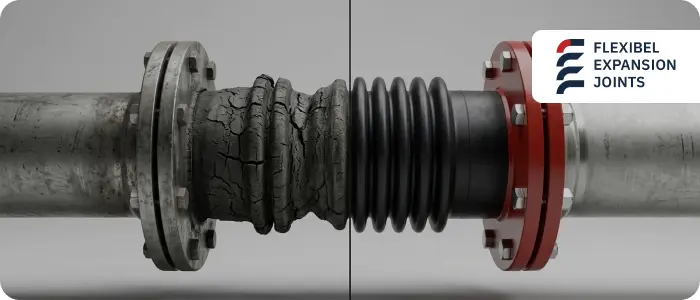
The tricky part? Most failures don’t happen suddenly.
If you know what to look for, you can catch the issue early, before it turns into downtime.
In controlled conditions, expansion joints perform exactly as expected.
But real systems aren’t controlled.
The desert-like environment of the UAE, Saudi Arabia, Qatar, Bahrain, Kuwait, and parts of Italy and Spain creates dramatic temperature fluctuations as well as extreme operating loads. That results in accelerated wear on all types of expansion joints, including metallic expansion joints,rubber expansion joints, and fabric expansion joints.
You’ll often see joints that look fine from a distance but are already under stress internally.
This is something teams working with Flexibel often point out during on-site evaluations. The issue isn’t always visible, but it’s there.
That’s why regular Expansion Joint Inspection is not just good practice. It’s necessary.
Learn More: Custom Expansion Joint Solutions for Industrial Applications
Cracks don’t appear overnight. They start small.
In Rubber Expansion Joints, you might notice surface cracks. In metallic ones, slight deformation or thinning. With Fabric Expansion Joints, fraying edges are usually the first sign.
It’s easy to ignore these. But once they appear, the material has already started degrading.
That’s usually the beginning of Damaged Expansion Joints.
A small leak rarely stays small.
It might start as slight moisture around the joint. Then it builds. In high-pressure systems, that’s not something you want to wait on.
Leakage is one of the clearest expansion joint failure signs, especially in steam or chemical lines.
At that point, you’re already looking at Expansion Joint Replacement, not repair.
Operators usually notice this first.
Something feels different. The system sounds slightly louder. The equipment vibrates more than before.
That often means the joint is no longer absorbing movement properly.
Worn Expansion Joints don’t isolate vibration; they pass it on. And that affects everything connected to the system.
If pipes start shifting out of position, something isn’t doing its job.
A working Flexible Pipe Connector or Flexible Joint keeps alignment in check. When it fails, the stress moves elsewhere.
You might see uneven spacing, flange strain, or difficulty during maintenance.
These are early signs that the joint has become a Faulty Expansion Joint.
Check out: Expert Guide to Flexible Pipe Connectors
Expansion joints are supposed to move. That’s their job.
The issue is that they will become rigid, and they will no longer respond as you expect them to function.
This is typical of Bellows Expansion Joint systems, where the Expansion Bellows can lose their flexibility over time.
Once the flexibility is no longer present in the Expansion Bellows, the stresses will build up at an accelerated rate.
This one depends on the environment.
In metallic joints, corrosion weakens the structure. In rubber or fabric types, chemical exposure or heat causes a gradual breakdown.
It’s not always dramatic; sometimes, just discoloration or surface change.
But it’s a clear sign the material isn’t what it used to be.
This is usually the point where teams realize something isn’t right.
If a joint keeps needing attention, it’s not a maintenance issue anymore.
It’s time for industrial expansion joints replacement.
Following an expansion joint maintenance guide helps, but it also tells you when maintenance is no longer enough.
A lot of people wait too long.
If you’re asking how to know if an expansion joint needs replacement, here’s the simple answer:
Delaying it doesn’t save costs. It shifts the cost somewhere else, usually into bigger repairs.
Regular Expansion Joint Inspection changes everything.
Not just visual checks, but actually observing how the system behaves.
These small checks help catch issues early, before they escalate.
A lot of failures aren’t just about the joint.
They’re about how the system was designed.
Good Piping Design considers movement from the start. It includes the right type of joint, placed correctly, with proper support.
When that’s missing, even a good joint won’t last long.
Not all expansion joints perform the same, and replacing an existing joint with a like-for-like option does not always resolve the root cause of failure.
A proper replacement decision should consider:
In many industrial systems, failure occurs not because the joint was defective, but because it was incorrectly selected for the application.
This is where experienced manufacturers play a critical role. Flexibel Expansion Joints (Flexibel), a UAE-based manufacturer and supplier of metallic, rubber, and fabric expansion bellows established in 2012, emphasize engineered piping solutions tailored to demanding sectors like oil & gas, marine, and HVAC. This system-level approach helps ensure the replacement joint performs reliably under real operating conditions.
Selecting the right replacement ultimately improves service life, operational safety, and long-term system reliability.

Most systems don’t fail suddenly. They give signals.
Cracks. Leaks. Vibration. Misalignment.
The problem is, those signals are easy to overlook, until they’re not.
Recognizing the Signs Your Expansion Joints Need Replacement early can save more than just repair costs. It keeps the system stable.
Because in industrial piping, it’s rarely one big failure.
It’s a series of small things that were ignored for too long.