Industrial machinery is designed to withstand pressures, temperatures, and operate in continuous cycles; however, movement can cause problems. Pipes will expand as they heat up, ductwork will shift from the weight of the loads it supports, and vibrations will pass through all equipment every day. Over time, even small amounts of uncontrolled movement can damage connected systems.
This is a primary reason why modern-day processing sectors regard industrial expansion joints as crucial. Expansion joints perform several functions in addition to absorbing thermal expansion from the multitude of processes, including reducing mechanical stress on piping systems, isolating vibration that could cause unforeseen damage to other equipment, and extending the life of the equipment in an industrial facility
When there is an inappropriate selection of expansion joints, there tend to be many problems in an industrial facility that happen repeatedly, including the following problems:
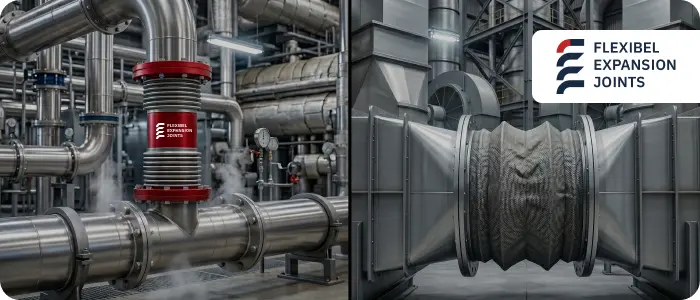
A difficulty with designing and manufacturing an expansion joint is that not all joints can be designed or manufactured to perform under any set of conditions. There are two varieties of expansion joints most commonly used in industrial applications. They are fabric expansion joints and metallic expansion joints. Both types of expansion joints will absorb motion; but they absorb it in distinctly different ways and are used in two separate types of manufacturing environments.
For example, if you have a metallic expansion joint that performs well in a high-pressure steam line, it may fail within a relatively short time in a large flexible duct system. Similarly, a fabric joint designed for exhaust gas movement cannot safely handle pressurized liquid service.
When selecting a joint, remember that this is more than just a buying decision - it influences reliability, maintenance, safety of the plant, and long-term operational performance.
This guideline will review the differences for both types of expansion joints; metal and fabric, how they are generally used, and the various engineering aspects associated with choosing the correct type of joint for industrial customers.
Industrial expansion joints are flexible components designed to absorb thermal expansion, vibration, pressure changes, and movement in piping and ducting systems. They play a critical role in protecting industrial equipment from stress, preventing structural damage, and improving the overall safety and efficiency of industrial operations.
Every industrial system experiences movement during operation.
Temperature changes cause pipes and ducts to expand and contract. Rotating equipment introduces vibration into connected systems. Pressure variation creates additional mechanical stress across pipelines and ducting networks.
Expansion joints are designed to absorb those movements before they transfer damage to the surrounding structure.
This is why expansion joints in industrial facilities are critical in systems exposed to:
A properly selected expansion joint helps with:
In many industrial facilities, expansion joints act as a protective component that helps extend the lifespan of surrounding equipment.
Learn More: Benefits of Expansion Joints in Industrial Piping Systems
Expansion joints are used across industries where heat, pressure, or movement are part of regular operation.
Common industries include:
The type of expansion joint selected depends heavily on operating conditions, media type, movement range, and system design.
Check out: Expansion Joint Installation Guide for Industrial Systems
Metallic expansion joints are engineered flexible connectors primarily used in high-pressure and high-temperature industrial piping systems. Made from stainless steel bellows and welded metal assemblies, they absorb thermal expansion, vibration, and mechanical movement while maintaining system integrity and operational safety.
Metallic expansion joints are engineered primarily for pressurized piping systems. They are commonly manufactured using stainless steel bellows designed to flex while maintaining pressure integrity.
Most metallic assemblies include:
During operation, as valves articulate, the bellows section will compress or expand to facilitate controlled movement without placing an extraordinary amount of strain on the piping system. The material selected for constructs will vary based on the operating temperature and pressure, as well as corrosion exposure. The most common materials used are:
In corrosive or marine environments, higher-grade materials are often required for longer service life.
The main advantage of metallic expansion joints is their ability to operate under high-pressure and high-temperature conditions simultaneously.
Key characteristics include:
Unlike fabric systems, metallic bellows are specifically designed to contain pressure while absorbing controlled movement.
They are commonly used in critical systems where operational reliability is essential.
Metallic joints are widely installed in:
In many facilities, expansion joints for pipelines are treated as critical mechanical components because failure can directly impact production continuity and plant safety.
Power plants are a common example. Steam pipelines regularly expand and contract during operating cycles. Metallic bellows absorb that movement while maintaining structural stability across the system.
Learn More: Metal Expansion Joints Guide: Design, Uses, and Advantages
Fabric expansion joints are flexible connectors designed for low-pressure ducting and exhaust systems in industrial applications. Made from multiple layers of high-performance fabrics and insulation materials, they absorb thermal movement, vibration, and misalignment while providing excellent flexibility in large duct and flue gas systems.
Fabric expansion joints are mainly used in low-pressure ducting systems handling gases and air movement.
Instead of metallic bellows, these joints use multiple layers of engineered composite materials designed to remain flexible under operating temperatures.
A typical fabric assembly may include:
With a layered construction, the joint can accommodate a large amount of movement and be lightweight and flexible. Compared with metallic systems, fabric joints have a much broader range of adaptability for larger diameter duct systems.
One of the biggest advantages of fabric expansion joints is their movement capability.
Key characteristics include:
Fabric joints are particularly effective in applications where vibration isolation and thermal movement are more important than pressure containment.
Many facilities also prefer them in large duct systems because installation and replacement are generally easier compared to heavier metallic assemblies.
Fabric joints are commonly used in:
In many duct expansion joints used across industrial facilities, flexibility becomes the primary requirement rather than pressure resistance.
This is especially common in large exhaust systems operating under continuous thermal cycling.
Know More: Importance of Fabric Expansion Joints in Industrial Applications
| Feature | Metallic Expansion Joints | Fabric Expansion Joints |
|---|---|---|
| Temperature Resistance | Very High | High |
| Pressure Handling | Excellent | Low |
| Flexibility | Moderate | Very High |
| Weight | Heavy | Lightweight |
| Maintenance | Low | Moderate |
| Ideal Use | Pipelines | Ducting Systems |
| Vibration Isolation | Medium | Excellent |
| Cost | Higher initial | Economical |
Both metallic expansion joints and fabric expansion joints serve important industrial purposes, but they are designed for different operating conditions.
In simple terms:
Understanding that distinction prevents many common specification mistakes.
Also Read: Metal Expansion Joints vs. Rubber Expansion Joints: Engineering Selection Guide
There are situations where metallic systems are clearly the better option.
Metallic expansion joints are generally selected when the application involves:
In refinery systems, pipelines often experience repeated thermal cycling during operation. Metallic bellows absorb movement while maintaining pressure containment.
Similarly, turbine piping systems in power plants require joints capable of handling both vibration and extreme temperatures simultaneously.
For facilities operating under demanding conditions, metallic assemblies remain one of the most reliable high temperature expansion joints available.
Check out: Metallic Expansion Joints Products
Fabric systems are generally preferred in low-pressure gas handling applications where flexibility becomes more important than structural rigidity.
Fabric expansion joints are commonly selected when:
Cement manufacturing facilities are a common example.
Exhaust ducts inside cement plants experience significant movement during operation. Rigid systems would transfer excessive stress into connected duct sections and support structures.
Fabric joints absorb that movement more effectively.
Similarly, flue gas systems in power plants frequently use fabric assemblies because they provide excellent flexibility and vibration control.
Many industrial duct expansion joints Middle East facilities rely on today are fabric-based because they perform efficiently under continuous high-temperature gas conditions.
Check out: Fabric Expansion Joint Product
Expansion joint failures are often linked to incorrect selection rather than manufacturing quality.
Several specification mistakes appear repeatedly across industrial projects.
Temperature is important, but pressure, vibration, and movement range are equally critical.
A joint may survive the heat while failing mechanically because other operating conditions were ignored.
Many systems experience combined:
Underestimating movement range is one of the most common causes of premature failure.
Material compatibility becomes critical in corrosive environments.
Marine facilities, chemical plants, and flue gas systems often require specialized materials capable of resisting aggressive operating conditions.
Continuous vibration from turbines, compressors, and fans accelerates fatigue damage over time.
Improper vibration evaluation often shortens joint lifespan significantly.
Even correctly selected joints may fail if installation alignment, support spacing, or surrounding structure conditions are poor.
Real operating conditions always matter more than theoretical calculations alone.
Operating temperature directly affects:
Both metallic and fabric systems handle temperature differently depending on whether the media is gas, liquid, or steam.
Pressure capability is one of the clearest differences between both systems.
Metallic bellows are engineered for pressurized service, while fabric systems are primarily designed for low-pressure environments.
Large industrial duct systems often require significantly higher movement capability compared to piping systems.
This is where fabric joints generally provide better flexibility.
Liquid systems usually require metallic assemblies because pressure containment becomes essential.
Gas systems allow greater flexibility in joint selection.
Compact piping layouts often favor metallic bellows because of their smaller installation footprint.
Large duct systems generally provide more room for flexible fabric assemblies.
Inspection access should always be considered during system design.
Poor accessibility increases maintenance downtime and replacement difficulty later.
Industrial operating conditions across the UAE and Middle East can be extremely demanding.
Facilities regularly operate under:
Because many plants in the region operate continuously, reliability becomes a major priority.
This is why properly engineered industrial expansion joints UAE industries depend on are rarely selected as generic standard components.
Marine and offshore facilities around the Gulf region, for example, require materials capable of handling corrosion, heat, and vibration simultaneously.
Similarly, power generation and cement industries across the region commonly use both metallic expansion joints and fabric expansion joints depending on system requirements.
Selecting the wrong configuration in these conditions usually leads to faster wear and recurring maintenance problems.
Expansion joints directly affect system reliability.
Improperly selected joints may initially appear functional but gradually introduce stress into surrounding systems.
Over time, that can lead to:
Properly engineered flexible expansion joints reduce those risks significantly.
They also help improve:
In large industrial facilities, preventing even one unexpected shutdown can result in significant operational savings.
Flexibel is the UAE based trusted manufacturer and supplier of expansion joints below with highest quality standard in the Middle East.
The company supports applications involving:
Services include:
Instead of applying the same solution for all systems, Flexibel analyzes the operating conditions, movement requirements, and environmental exposure prior to making a configuration recommendation.
This approach, based on engineering, will be especially important for those industries whose reliability is directly related to their Operational Continuity.

Both metallic expansion joints and fabric expansion joints serve important roles in industrial systems, but they are designed for different operating conditions.
Metallic systems are generally preferred for high-pressure pipelines, steam service, and mechanically demanding environments.
Fabric systems perform better in low-pressure ducting applications where flexibility, vibration absorption, and large movement capability are priorities.
Selecting the correct solution requires evaluating temperature, pressure, movement range, media type, installation conditions, and environmental exposure together.
Facilities that approach expansion joint selection carefully usually experience:
For industrial projects requiring engineered guidance and application-specific solutions, consulting experienced specialists like Flexibel helps ensure the selected expansion joint matches real operating demands rather than generic assumptions.